2025 has been a pivotal year for Sarawak. For the first time, the entire immigration system is digitised. While West Malaysia has introduced various digitisation efforts in stages since 2013 (over 12 years), Sarawak’s digitisation pathway happened very suddenly across many verticals in the course of one year (in 2025).
After a long wait, finally, it’s decided. Sarawak will maintain her own immigration control system via an independent integrated digital ecosystem led by the Foreign Worker Transformation Approach (FWTA) ecosystem. The FWTA was introduced in multiple stages. And it seems that the government has taken a business first approach to the roll out, starting with the biggest pain point for Sarawakian employers - labour quota applications.
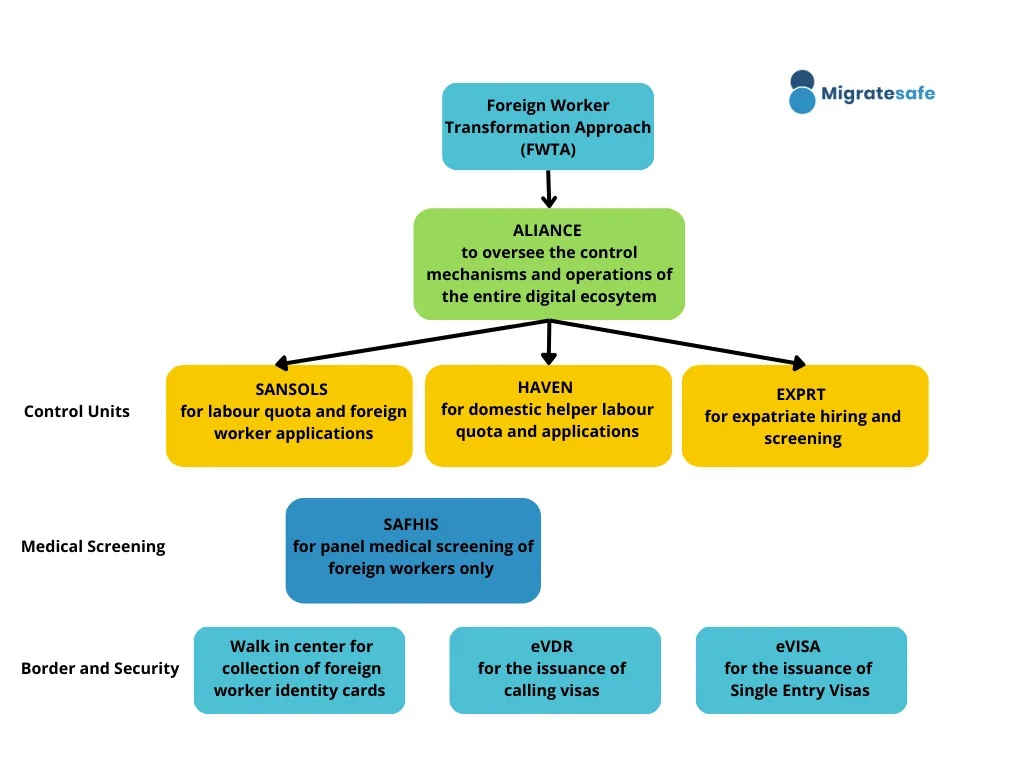
The flowchart provides a snapshot of the new digital ecosystem.
| Abbreviation | What does it stand for? |
|---|---|
| ALIANCE | Advanced Labour and Immigration Network Aligned Network for Compliance |
| SANSOLS | Sarawak Advanced Non-Sarawakian Online System |
| SAFHIS | Sarawak Foreigners Health Information System |
| HAVEN | Household and Assistance Vetting & Employment Network |
| EXPRT | Expatriate Platform for Recruitment and Talent |
January 2025: Labour Quota and Foreign Worker Applications under SANSOLS
The initial phase of the FWTA policy focused on streamlining foreign worker labour quota applications, a notorious bottleneck under the previous MSEN3 system.
The pilot phase commenced in January 2025, with reports indicating massive initial engagement of over 18,000 companies registered to date. By the end of 2025, more than 110,000 headcount had been approved through the system. A significant milestone is the drastic reduction in processing time for labour quotas, which reportedly shortened from a cumbersome 6 to 9 months timeline under the old MSEN3 platform to just under 2 months with the new digital process. This speedup has provided much-needed predictability for employers.
Industry sentiment about the digital migration and increased costs
Earlier in January 2025, the industry sentiment about digitisation was rather positive with many applauding the government for their commitment to reducing administrative burdens for companies hiring foreign workers. But over the course of the year, concerns over the new administrative costs heightened, which significantly disrupts budgeting and distorts pricing competitiveness of Sarawakian companies in Malaysia.
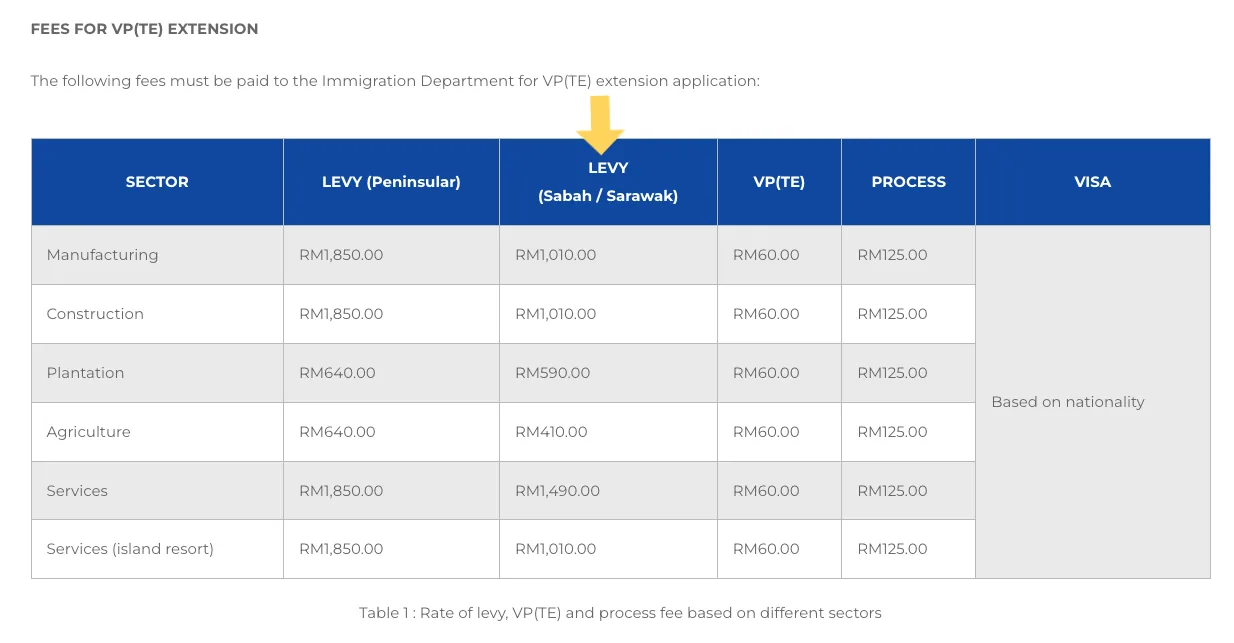
Picture: Pre-existing immigration levies as stated on the immigration website (imi.gov.my) paid annually to the Federal Government before the addition of the SANSOLS administrative costs.
Datuk Dr Ngu Piew Seng, President of the Sri Aman Chinese Chamber of Commerce openly spoke out about the RM1,854 application fee per foreign worker, or RM2002.30 after including sales and service tax. He laments this cost as the highest in the country, while the new system is still undergoing many technical issues. He also highlighted that these sudden and high imposition of costs threaten the survival of many businesses.
Similar concerns have also been raised by the Sarawak Timber Association (STA) representing the timber industry, Sarawak Association of Marine Industries (SAMIN) representing the Shipbuilding industry, Sarawak Housing and Real Estate Developer Association (SHEDA) representing Property Developers, The Sarawak Dayak Oil Palm Planters Association (DOPPA) representing plantations.
These new costs also significantly disadvantages SMEs, driving bigger gaps between SMEs and larger companies who can absorb these new costs. SMEs hiring foreign workers exist across various service sectors, construction contractors, vehicle workshops, kopitiams, spas, and smaller plantation or agricultural businesses.
From the government’s perspective, these fees are reasonable and justified. They are not just costs imposed to process paperwork, but also costs needed to maintain the ecosystem and offer better services to employers. It is no surprise that the FWTA will involve hiring new headcount, setting up new physical centers, and paying service providers to maintain the new digital ecosystem. Perhaps what employers are frustrated about is not how much it cost, but rather who's paying for it. With the sudden implementation of the FWTA and the lack of prior stakeholder consultation, it seems that the government has made a unilateral decision for the FWTA infrastructure to be “fully financed by the private sector”. This begs the question of whether the FWTA should have secured a budget allocation prior to implementation, instead of passing the cost on to companies and assume that they can and should just absorb this cost.
Foreign Worker Labour Shortages and Quality Issues
Emerging from Covid post 2022, the headlines on the foreign worker situation in Sarawak highlighted huge labour shortages of up to 40,000, particularly in oil palm plantations. These numbers are significant, considering Sarawak’s allocation is only a ceiling of 150,000. Since then, Sarawak has explored the possibility of new source countries, namely Nepal, Bangladesh, India and the Philippines to meet the severe labour shortages. But exploring new source countries has been done cautiously. So far, only small labour quotas have been approved for a select number of construction and plantation companies. All these years, Sarawak has maintained only one approved source country - Indonesia. Openly recognising more official source countries in 2023 marks a significant shift in our region's immigration policy.
Secondly, Sarawak also faces a big issue with quality of labour. Primarily driven by geographical factors (limited flights and accessibility), but also in part due to its long standing closed door policy. In a training co-hosted by the International Organisation for Migration (IOM) and the Federation of Malaysian Manufacturers (FMM) in Kuching (May 2025), Sarawakian employers reported abscondment (runaway) rates averaging 70%. This figure signals a big distortion in the quality of the labour supply market. It also highlights issues with poor employment migration and high risk of human trafficking practices. These are systemic issues which are complex and difficult to tackle. The disappointment often faced by employers in this aspect also relates back to the pushback on new administrative costs. Employers don’t feel secure to invest when the risks are this high.
To access better quality workers who are committed and migration prepared, Sarawak employers must have access to the best labour suppliers. In Indonesia, these suppliers are almost exclusively based in Java. The Java based suppliers understand the need and standards of the international labour market. Their operations are large and set up to ensure that outbound workers are committed, trained, and migration ready. All this while, Sarawakian employers rely on supply of labour from Kalimantan who come and go as they please. Further, our unregulated market creates easy access for middlemen profiteers to orchestrate mass illegal migration across the Sarawak-Kalimantan land border with little impunity.
Deception and widespread job substitution are commonplace to make a quick buck here. For example, male workers are frequently promised jobs in construction and manufacturing, but find themselves placed on remote plantations with low wages. While female workers are promised jobs in the service sector, only to find themselves isolated in households as domestic workers with their handphones, passports and salary taken from them. With such recruitment practices in place, it’s no surprise that Sarawakian employers struggle to find and sustain good labour.
Setting the foundation for a more open Sarawak policy while balancing federal policies
The current federal administration is cutting back dependency on foreign labour and expatriates. This direction is at odds with the current needs of Sarawak where our economy is growing rapidly and labour demands are higher than ever. In part, this causes tension to balance Sarawak’s growth needs with the Federal policy on immigration. One commonality though is the enforcement of our borders. The Federal government has also made special allocations in 2023 and 2024 to improve Immigration, Customs, Quarantine and Security Complex (ICQS) in Sabah and Sarawak. The budget allocations are reported to have exceeded 1 billion ringgit, potentially going up to 2 billion ringgit to provide more enforcement to the Sabah-Sarawak-Kalimantan border. In many ways, the ramp up of these initiatives will also reduce illegal entry and trafficking activities along our permeable border.
After Covid, the Journey Performed Visa (JPV) has also been discontinued in Sarawak to prevent or discourage entry without prior approval. This change came about because the Sarawak government was concerned about illegal entry and unmonitored spread of the virus at the time. Further, there are talks of only allowing work permit endorsements via entry by air rather than the land border. This will eventually deter a common practice at our land borders where passports are “flying” without physical entries or exits.
July 2025: Domestic helper applications under a new module known as HAVEN
The pilot of domestic helper applications via the HAVEN module started around July 2025. Significant disruption has been caused to this pipeline due to the complete overhaul of its approval processes. Previously, only the immigration department was involved in the approval of Indonesian domestic helper visas. Now the State and the Labour Department are also added to the approval process. This unfortunately prolonged processes by 4 - 5 months compared to previous timelines. Long processing timelines deter competitive workers from coming to our market. And over time, it will segment workers from poorer and more rural areas who require more financing and training to arrive in our market. This will increase the cost of hiring for household employers in Sarawak over time, while leaving our employers with the least competitive pool of workers.
In addition, starting 1 January 2026, households will need to fork up another RM1854 for each domestic helper hire. Household employers needing essential and affordable care services at home can expect an increase in prices in January 2026. There is optimism that with the system moving online, employers will actually save more by reducing their dependence on agents. However, our learnings from West Malaysia has shown that direct hiring initiatives in the domestic helper industry have rarely seen success in Malaysia. If anything, such initiatives always backfire and enable more resourceful unlicensed agents to enter the market, without addressing cost concerns for employers.
The issues are twofold. Firstly, for household employers to use an online system to bypass middlemen requires a lot of resourcefulness to (1) source a worker who is suitable for their household and (2) mobilise the worker to make a passport, complete her medical examinations in her source country, and travel on her own to Malaysia. A small majority of household employers, approximately 15 - 20% have shown capabilities to do so. But the majority still rely on middlemen due the complex nature of cross border economic migration. It’s not as simple as just “taking a flight”.
This brings us to the second issue. Source countries impose stringent exit requirements for vulnerable workers. Domestic workers fall squarely within this protected category because (1) they are women, and (2) they are also typically the poorest economic migrants. The Philippines government requires all workers to have registered contracts in the countries they are travelling to for work, and must present an Overseas Employment Certificate (OEC) at border control or be denied exit. The Indonesian government requires all workers to have a Pekerja Migran Indonesia (PMI) card prior to exit. Both countries necessitate the use of employment agencies in the source country and also in Malaysia for workers to obtain these documents. This is why a direct hiring platform for domestic helpers only solves part of the problem.
November 2025: Expatriate applications moving online with the launch of the EXPRT module
Migrating expatriate applications online has been a game changer in Sarawak, moving away from the gatekeeping practices of the past due to the limitations of a paper based manual system. Streamlining expatriate applications online has given the State government a lot more control and oversight over which companies get to hire expatriates and what kind of talent should be allowed. More importantly, the expatriate services division has always been well-staffed and run quite efficiently compared to the other units. Therefore, it is the unit that has been most well prepared for digital migration.
With direct applications reaching the State Secretary Office, there will also be clearer insights on the type of skilled talents Sarawakian clients need and this will make way for better talent management policies. Of course, there has also been an increase in administrative fees for employers hiring expatriates too. However, the increase of RM1854 is not far behind the fees imposed for employment pass applications (RM2,160 including SST) in West Malaysia in 2024/25. Companies are also more prepared to spend on their skilled talents than the blue or grey collar positions where hiring is voluminous.
We foresee that the digital migration for expatriates will yield a lot of immediate success. Sarawakian companies can also sigh a breath of relief with this much welcomed speed and transparency as long and uncertain processing times has always been the main deterrent for West Malaysian and foreign skilled talent to land and stay in Sarawak.
At the moment, the professional visit passes, dependent passes, and the spouse programme (employment pass) are still kept out of the system and is still proceeding manually. It is very likely that these processes will also move online in due course.
More in 2026 for foreign spouses and non-Malaysian family members?
There are also hints that the Permanent Residency (PR) applications will be included in the ALIANCE ecosystem. If this does happen, it will put Sarawak at the forefront of transparency with PR applications, signalling a strong commitment for Sarawakians to return home with non-Sarawakian or non-Malaysian family members. Current PR applications in Sarawak can take anywhere between 1 to 30+ years depending on the gender and nationality of the foreign spouse. Complications also exist between non-Sarawakian Malaysian wives and husbands, with the husbands facing deep uncertainties with long term settlement in Sarawak. It would be interesting to see if the government will also extend the digitisation to other family pass categories including the Long Term Social Visit Passes, Work Endorsements for spouses, and Guardian passes for divorced or widowed spouses.
Conclusion
There’s no doubt that all of these changes have been frustrating and difficult for Sarawak. But overall, we are forecasting a net positive. The FWTA costs will need to be revised. Stakeholder engagements should have happened, while noting that these roll outs are never perfect. The Sarawak government has a big task at hand. Sentiments of conservatism exist amongst the business community because of the fragile environment we have always operated in. Nevertheless, Sarawak is preparing itself for more growth, and these changes are part of the government’s commitment to digitise Sarawak government services by 2030. It is a big leap forward in the right direction. Despite the existing challenges and setbacks, digitisation is necessary for modernisation. If anything, this experience has highlighted the importance of transparency, not just in processes, but also in stakeholder engagement and decision making. Stability, efficiency and transparency are on the wish list of Sarawakian employers in 2026.
Tell us what you need
Describe your situation and we’ll tell you which pass fits it, what it costs and how long it takes.
Mon–Fri, 9am–6pm · WhatsApp 1 business day · Email 1–2 business days